- Home
- Fire Extinguishers
Fire Extinguishers
We supply, install and maintain a complete range of quality portable fire fighting equipment, portable fire extinguishers, hose reels, fire blankets and signage.
Classes of fire
There are six different types or classes of fire, each of which has extinguishers to tackle the specific types of fire. Newer fire extinguishers use a picture/labelling system to designate which types of fires they are to be used on. Additionally, the majority of fire extinguishers have a numerical rating which is based on tests conducted by professional fire-fighters that are designed to determine the extinguishing potential for each size and type of extinguisher.
Class A Fire

A: Solid
The numerical value on an extinguisher designed to tackle Class A fires represents the size of fire in cubic metres that the extinguisher can put out.
Class B Fire

B: Liquid
The numerical value represents the amount of litres of flammable liquid that can be extinguished.
Class C Fire

C: Gaseous
No numerical value. Flammable gas is very difficult to measure in cubic metres–it depends on the ratio of gas to air there is in the local atmosphere.
Class D Fire

D: Metal
The numerical value represents the size of fire in cubic metres that the extinguisher can put out.
Class E Fire

E: Electricity
No numerical value. Once the source of the electricity is shut down, the electrical fire will revert to a different class.
Class F Fire

F: Cooking oils
The numerical value represents the amount of litres of flammable liquid (cooking oils etc) that can be extinguished.
Choosing an extinguisher
|
|
|
|
|
|
|---|---|---|---|---|---|
| Water |  |
||||
| AFFF Foam | |
|
|||
| CO2 | |
|
|||
| ABC Powder | |
|
|
|
|
| Wet Chemical | |
|
Water Extinguisher
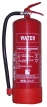
Water extinguishers are one of the cheapest and most widely used extinguishers available. They are good for tackling fires involving burning paper, wood and soft furnishings, as the water soaks into the materials (Class A fires).This type of extinguisher does not leave a residue , but does have a comparatively low rating. Due to this factor water extinguishers are larger and heavier to overcome their lacking in fire fighting power. It is important to remember that water is a electrolyte and conducts electricity. Care must therefore be taken with regards to accidental use on mains power. These problems can, however be overcome by installing water extinguishers with additive. This type of extinguisher has a higher fire rating, which therefore reduces the weight of the extinguisher and removes the risk of self-electrocution.
Foam Extinguisher
Foam extinguishers are more versatile than the water extinguisher. They can be used on fires involving wood, paper, textiles, plastics and flammable liquids: such as paraffin, petrol, and oil; and are suitable for areas where soft furnishings and carpets are present (Class A and B fires).Foam extinguishers are safe to use with regards to electrical risk. This type of extinguisher usually contains additives which are carcinogenic, making the cleaning process of the premises after the event of a fire more problematic.
CO2 (Carbon Dioxide) Extinguishers
CO2 extinguishers contain only pressurised CO2 gas and leave no residue. This type of extinguisher is suitable for use on fires involving burning liquids (Class B fires), but is also an excellent solution for quenching fires involving computer equipment and other electrical appliances , as it does not cause damage to the electrical items and does not cause the system to short circuit. It is important to remember that when using CO2 extinguishers there is a possibility that once the gas has floated away the fire may re-ignite if the source of the fire is not removed (eg switching off the power supply). Please be aware that CO2 extinguishers that are not fitted with double-lined swivel horns may cause your fingers to freeze to the horn during the deployment of the CO2 gas.
Powder Extinguisher
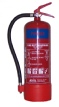
Multi-purpose powder extinguishers are suited to fighting class A, B and C fires–and hence are also called ABC extinguishers. That means they can be used on fires involving wood, paper, textiles, plastics, flammable liquids (such as paraffin, petrol, oil), flammable gasses (such as propane, butane, methane) and also those fires involving electricity.
Powder extinguishers have a good fire fighting capacity, but this agent does not soak into materials and does not have a cooling effect on the fire. This could result in the fire re-igniting, if it is not properly extinguished. Care must be taken when using powder extinguishers and they should not be used in small confined spaces where there is a risk of inhalation of the powder.
Wet Chemical Extinguishers

Wet Chemical fire extinguishers are suitable for use with fires involving burning oil and deep fat fryers (Class F fires). These extinguishers come with a special application lance which lays a cooling layer of foam on top of the burning oil. Alternatively a fire blanket can be placed over the pan containing the burning oil. The pan should then be left to cool down. NEVER carry the pan outside or lift the fire blanket after a short period of time to inspect the burning oil as introducing oxygen through this action could re-ignite the fire. NEVER use pressurised water, powder or foam extinguisher on fires involving burning oils as the pressurised jet will cause the burning oil to be carried out of the pan onto surrounding surfaces causing more damage and a larger fire to tackle.
Servicing
Regulations and Servicing of your Extinguishers
By law, employers must provide their staff with adequate means of tackling a fire in the workplace. There is also a legal obligation for a competent person to annually service the fire extinguishers to standard BS 5306 part 3. In addition, all fire extinguishers must be maintained in working order and in good repair in between the services. This means that workplaces must also ensure that they carry out their own checks, at least monthly.
A competent person is defined by the British Standard as:
‘a person with the necessary training and experience, with access to the relevant tools, equipment and information, manuals and knowledge of any special procedures recommended by the manufacturer of the portable fire extinguisher, to be capable of carrying out the relevant maintenance procedures of this standard.’
We recommend using a UKFA or BAFE registered company which employs qualified technicians, who undergo refresher training every 3 years to keep their industry knowledge up to date.
Monthly Visual Inspection
- Check for any sign of tampering. This may be missing or broken tamper tags or pins.
- Look for any signs of discharge. This may be water, powder or foam traces on the hose or horn of the extinguisher.
- Gauges showing low or high pressure (usually indicated by red).
- Any damage to fire extinguishers: rust, dents, missing parts etc.
Workplaces with a high risk of damage to their fire extinguishers such as those kept on haulage vehicles should be particularly vigilant. Any damaged extinguishers should be replaced immediately or repaired by a servicing company.
Annual Service
During a basic annual service, the fire extinguisher technician carries out various procedures on the fire extinguishers depending on their make and type. Generally, the service includes:
- Checking all fire extinguisher parts such as: valves, safety devices, gauges, and operating mechanisms.
- Checking that the pressure and weight is within the stated range.
- Issuing a Certificate of Inspection–a legal record of the maintenance carried out on the fire extinguishers to be kept by the customer and technician.
Extended Service (Discharge and Refill)
Extended service generally involves carrying out a test discharge on the fire extinguisher, checking internal and external parts, then recharging the fire extinguisher ready for use, if deemed safe by the engineer. BS 5306-3, states that water fire extinguishers, foam fire extinguishers, powder fire extinguishers and wet chemical fire extinguishers require an extended services every 5 years. CO2 fire extinguishers must have an overhaul and pressure test every 10 years. Most company’s carry out a ‘service exchange’ for CO2 and powder fire extinguishers due to be discharged. This entails exchanging your old extinguisher for a new or refurbished extinguisher. Buying new fire extinguishers from Fireguard may prove to be more cost effective than service–exchanging old units.
Training
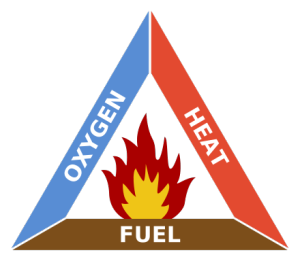
The triangle illustrates the three elements a fire needs to ignite: heat, fuel, and an oxidizing agent (usually oxygen). A fire naturally occurs when the elements are present and combined in the right mixture, and a fire can be prevented or extinguished by removing any one of the elements in the fire triangle. For example, covering a fire with a fire blanket removes the “oxygen” part of the triangle and can extinguish a fire.
Our training is done on your premises and includes: identifying different types of extinguishers and basic use for different types of fire. Participants will get the opportunity to discharge the different types of extinguishers.